
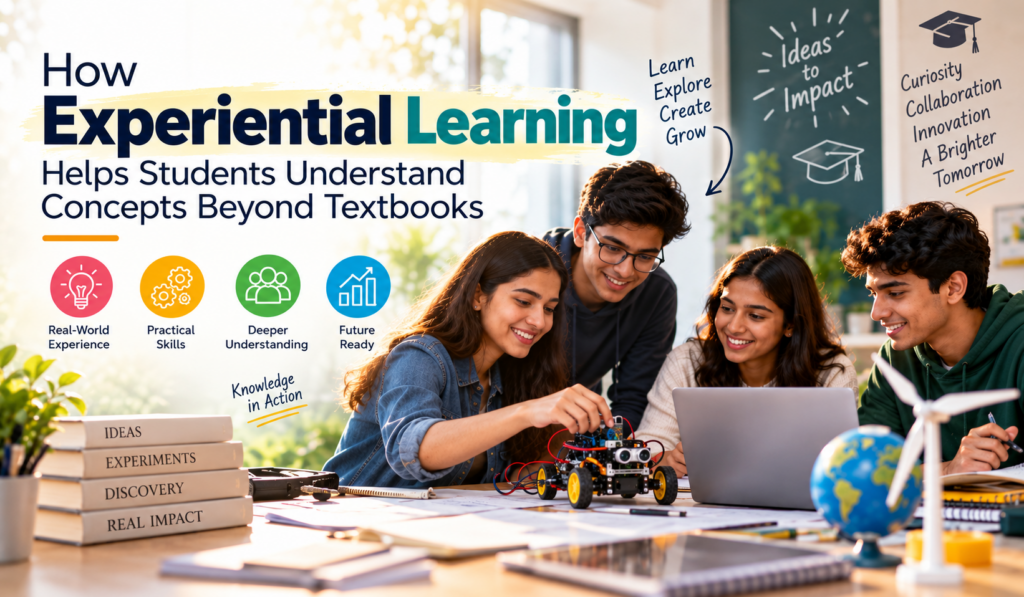
Education becomes truly meaningful when students can connect what they learn in the classroom with the world around them. While textbooks provide essential knowledge and structure, children often understand a concept better when they can see it, experience it, discuss it, and apply it themselves.
This is where experiential learning plays an important role. Instead of limiting education to reading, writing, and memorising, experiential learning encourages students to learn through activities, experiments, projects, observations, and real-life experiences.
At Shantiniketan Public School, Panvel, we believe that some of the most valuable lessons happen when students are actively involved in the learning process.
What Is Experiential Learning?
Experiential learning simply means learning through experience. A science concept becomes clearer when a student performs an experiment. Mathematics becomes more relatable when numbers are used in practical activities. Language skills improve when children participate in storytelling, public speaking, poetry, and conversations.
The same approach can be applied across subjects and age groups.
The objective is not to replace textbooks, but to take learning a step further. Students first understand a concept and then get an opportunity to experience how it works in practice.
Turning Classroom Lessons into Real Experiences
Imagine learning about plants only by reading the different parts of a plant in a textbook. Now imagine a child observing a real plant, identifying its roots, stem and leaves, and discussing how each part functions.
Both methods teach the same concept, but the second creates an experience that a child is more likely to remember.
Similarly, concepts such as tens and ones can be taught using objects and classroom games, languages can be strengthened through storytelling and recitation, and environmental awareness can be developed through practical activities that encourage students to care for their surroundings.
When children participate rather than simply listen, learning becomes more natural.
Why Experiential Learning Matters
1. It Makes Difficult Concepts Easier to Understand
Children have different learning styles. Some understand quickly by reading, while others need visual demonstrations or practical examples.
Hands-on activities allow students to observe a concept and understand why something happens instead of simply remembering that it happens.
This is particularly useful in subjects such as mathematics, science and technology, where practical application can make abstract concepts much easier to understand.
2. It Encourages Curiosity
A good learning environment should encourage children to ask questions.
Why did this happen?
What happens if wea change something?
Can we find another solution?
Experiential learning creates room for these questions. Students become active participants in the lesson rather than passive listeners.
This curiosity gradually develops into independent thinking and a genuine interest in learning.
3. It Develops Problem-Solving Skills
Not every activity works perfectly on the first attempt, and that itself can become an important lesson.
When students work on an experiment, model, puzzle or group project, they may need to identify what went wrong, reconsider their approach and try again.
Such experiences teach children that making mistakes is part of the learning process. They also develop patience, reasoning and the ability to approach challenges from different perspectives.
Learning Through Laboratories and Technology
Modern education increasingly requires students to understand how science and technology work beyond theoretical definitions.
Laboratories provide an environment where students can observe, experiment and discover concepts for themselves.
At Shantiniketan Public School, this approach also extends to technology-based learning. The school has introduced dedicated robotics periods, a Robotics Lab and instructors who guide students through practical learning experiences.
Through robotics and STEM-based activities, students can explore areas such as logical thinking, basic programming, engineering concepts, problem-solving and innovation.
Early exposure to these areas can also help students discover interests that may influence their future academic and career choices.
Building Communication and Teamwork
Experiential learning does not always happen individually.
Group projects, competitions, classroom activities, presentations and collaborative assignments require students to communicate with one another, listen to different ideas and work towards a common goal.
These experiences gradually strengthen teamwork, leadership and communication skills.
For example, a student participating in a group project learns much more than the subject itself. The child also learns how to share responsibilities, manage time, explain ideas and respect different viewpoints.
These are skills that remain valuable far beyond school.
Connecting Education with Everyday Life
One of the greatest strengths of experiential learning is its ability to answer a question students often have:
“Where will I use this in real life?”
Mathematics can be connected with money, measurement and everyday calculations. Environmental studies can be linked with waste management and conservation. Languages can be developed through conversations, speeches and storytelling. Science can be understood through experiments and observation.
When students recognise these connections, education stops feeling like a collection of isolated subjects and begins to make sense as part of everyday life.
Building Confidence Through Participation
Every child may not be comfortable expressing themselves through a written examination alone.
Some students discover their abilities through art. Others shine in sports, public speaking, science experiments, technology, music, competitions or teamwork.
Providing varied learning experiences gives children more opportunities to participate and discover what they are good at.
Completing a project, presenting an idea, building a model or solving a challenge gives students a sense of accomplishment. Over time, these small successes contribute to greater confidence and independence.
The Role of Teachers in Experiential Learning
Teachers remain central to the entire process.
Their role extends beyond explaining a chapter. They create situations where students can explore concepts, ask questions, experiment and reflect on what they have learned.
A well-planned activity is not simply “fun time.” It has a clear learning objective behind it.
The teacher connects the activity with the academic concept so that students understand both the experience and the lesson it represents.
Learning Beyond the Four Walls of the Classroom
Experiential education can also extend outside school.
Educational visits and field trips expose students to environments they may otherwise only read about. Visiting a workplace, museum, science centre, natural environment or other educational facility allows children to observe how concepts operate in the real world.
Such experiences can make classroom discussions more relevant and memorable.
They also introduce students to different professions, industries and possibilities for the future.
Preparing Students for a Changing World
The future will require students to do more than remember information. They will need to analyse situations, communicate effectively, adapt to new technologies, collaborate with others and develop solutions to unfamiliar problems.
Experiential learning helps develop these abilities from an early age.
Academic knowledge remains essential, but when it is combined with practical experience, creativity, values and critical thinking, students become better prepared to use what they know.
Learning by Doing at Shantiniketan Public School
At Shantiniketan Public School, Panvel, classroom education is complemented by activities that encourage students to participate, explore and apply their knowledge.
From subject-based classroom activities and laboratory learning to competitions, creative projects, value education, sports and robotics, students receive opportunities to experience learning in different ways.
The aim is simple: children should not only know the answer; they should understand the concept behind it.
Textbooks will always remain an important part of education, but the strongest learning often happens when knowledge moves from the page into real experience.
Experiential learning helps children understand concepts more deeply, retain knowledge for longer and develop skills that cannot always be measured through examinations alone.
By combining strong academics with hands-on experiences, schools can nurture students who are curious, confident and capable of applying their learning to the world around them.
For parents looking for a CBSE school in Panvel that encourages learning beyond textbooks, Shantiniketan Public School focuses on creating meaningful educational experiences that support both academic understanding and overall student development.